Thursday, March 26, 2009

Overrated Villains: Magneto

If you ask people who they think is the most badass villain in the Marvel universe, most people will probably say it's Magneto.

Everybody has a pretty favorable impression of the guy. Maybe it was the performances by Ian McKellen in the movies, maybe it's the similarity to righteous extremists like Malcolm X, or Hell, maybe it's just the fact that he's so powerful that he can give any group of the most powerful superheroes a run for their money.

But when you actually go back and read the comics, you'll find that Magneto isn't as badass and cool as you remember him to be.


In fact, Magneto tends to come off very much like a typical scheming supervillain from the Silver Age. Even as recent as his portrayal in Grant Morrison's NEW X-MEN run, Magneto may act with a moral righteousness behind his terrorism, but at heart he is still a moustache twirling supervillain with plans of world domination that are, at best, half baked and poorly executed.

I mean, how is it that the most powerful mutant in the world, one who is intelligent, educated, and has a more alluring promise to the ones disgruntled by anti-mutant prejudice than the X-Men do, loses time and time again to a bunch of teenagers with goofy powers like shooting eyebeams and making snowballs? If you ask me, he's more like a Scooby Doo villain shaking his fists at "those meddling kids" than he is a Malcolm X figure.

Couldn't we as readers be treated to a depiction of the character that fit our initial expectations? I'm not saying that Magneto should be so brutal and badass that he kills all the X-Men and takes over the world (although that would make a cool "What If?" story). I'm just saying that if you can tell at first glance that drilling to the center of the Earth from an Antarctic base, reversing the Earth's polarity, or choosing a Brotherhood that includes useless characters are bad ideas, then chances are Magneto could too. Let's see him hatch a real plan for once.

But even aside from his plans, there is a total lack of depth in the character that still makes him feel much cartooney than the other characters in the X family. Alan Moore once sardonically commented on Stan Lee's conception of Marvel characters from the rigid, old-school heroism of the DC universe by saying "...Stan Lee had this huge breakthrough of two-dimensional characters. So, they dress up in costumes and do good, but they've got a bad heart. Or a bad leg. I actually did think for a long while that having a bad leg was an actual character trait. "

No character fits this bill more than Magneto. You have two ingredients to make a Magneto.

1. Several large doses of wrath. I'm talking veins bulging, chair throwing, pants piss inducing fury.

2. Intermix some pathos for mutantkind throughout his character to make him feel like he has some kind of moral spectrum.

That's it.

On one hand, he's this world threatening evil supervillain.

But on the other, he's a guy that loves his mutant family and whose vegetarianism precludes him from eating the cude, cuddley animals he so adores.

Would it hurt for the guy to have a hair more depth to him than we've been given? I don't know about you guys, but if I need to see Scooby Doo villains, I can just watch Scooby Doo.

Wednesday, March 25, 2009

Harvey Pekar on Letterman in '87: On Strike Against NBC

While I generally enjoyed the American Splendor movie, one thing that disappointed me was that during the scene where Harvey goes on Letterman's show to protest against NBC and their owner General Electric we were shown a reenactment instead of the original footage. That was one of my favorite scenes in the comic, so I really wanted to see how it compared to the actual event.

I dug around on YouTube only to find other guest appearances on Letterman's show (he did several), but just a little while ago the actual interview was posted.

Pekar was just as grumpy and as sardonic as you'd expect. However, one thing that was surprising was that Pekar seems much more obnoxious and disruptive than in his portrayals in the movie and in his own comic.

The Marvel Book I'm Most Looking Forward To

Marvel has had a lot of great books lately. There's Fraction and Larroca's INVINCIBLE IRON MAN, Straczynski and Coipel's THOR, Garth Ennis's PUNISHER MAX, Ed Brubaker's work on both CAPTAIN AMERICA and DAREDEVIL, and Mark Millar's work on Wolverine: Old Man Logan.

What's the commonality between these? Critically acclaimed talent exercising their creative muscle telling relatively continuity free stories with their characters of choice. Judging by the fact that Marvel now has over 52% of the market share as well as the fact that of the seven total recipients for the Eisner award for Best Writer, two of them are current Marvel exclusives (Ed Brubaker won in '07 and '08 and Bendis won in '02 and '03) and all of them with the exception of Alan Moore have done work at Marvel in the last five years.

In short - Marvel is kicking ass. And they have yet another book that's going to be added to the aforementioned roster with WOLVERINE: WEAPON X by Jason Aaron and Ron Garney.


If you're not familiar with Jason Aaron, he's the writer of SCALPED, which is a crime comic that takes place on an Indian reservation and is quite possibly the single best Vertigo book right now, one that might possibly end up in the same ranks as Y: THE LAST MAN, PREACHER, and THE SANDMAN. It seemed like before I had the chance to even pick up the trades and see what everybody was talking about, Marvel had already picked up the guy in an exclusive deal, having Aaron pick up scripting duties on GHOST RIDER and WOLVERINE.

The WOLVERINE storyline he was hired to write was a 4 part storyline following the Messiah Complex storyline entitled Get Mystique. During the Messiah Complex storyline, several forces struggled for the life of the newest mutant baby to be born since the catastrophic House of M event where the mutant count was limited to only 198 and mutantkind was rendered essentially infertile. With mutant extinction just on the edge of the horizon, it doesn't take Professor X to tell you that this mutant baby is pretty damn important. In the midst of the chaos, Mystique steals the baby and nearly kills it in an act of selfishness.

What is Cyclops' response to this? Find Mystique, wherever the hell she is, and kill her. No questions asked. Just Wolverine and nobody else.

The whole storyline was Wolverine tracing her steps through the Middle East. As he gets closer and closer to her whereabouts, we're treated to flashbacks of Wolverine and Mystique's relationship through the ages as bank robbers in the 1920's and the long history of blood, betrayal, and sex that has happened since. To further complicate matters, Mystique has been using her shapeshifting powers to impersonate Wolverine as she savages her way through the countryside, so Wolverine isn't exactly greeted with friendly cooperation in his search.

What resulted was a really fun and imaginitive story that has actually reinvigorated my interest in the character. Previously I had always thought that Wolverine was a big cliche, another Clint Eastwood persona: a strong silent tragic hero with a rough and tumble attitude, a guilty conscience, and a heart of gold underneath that's visible underneath the layer of piss and vinegar.

Aaron brought out a new angle on the character by understanding that a character that has lived for 200+ years has a rich and complex history, any of which you can draw from in flashback sequences or have other figures from his past come back to bite him, something which seems so obvious in retrospect. He didn't change the character, but he figured out new situations to elicit what makes him resonate. Quite simply, he seemed like a very reasonable pick to write the book after Millar's completion of the Old Man Logan storyline.

Imagine my surprise when Marvel had not only taken my suggestion, but they'd taken it one step further and created a whole new book for him. WOLVERINE: WEAPON X will be a long running series done exclusively by Jason Aaron and artist Ron Garney. In a CBR X-position interview, Aaron gave some hints about what to expect that got me really pumped.

The book will be relatively continuity free ("This is a Wolverine series for people who've never read the character's adventures, who don't know anything about his long and complicated history"), will jump from genre to genre ("The first arc is a gritty, black-ops espionage tale. Future arcs will range from horror to even sci-fi"), and will be pretty high in the violence factor ("If I'm writing it, chances are it'll be bloody. I'm disturbed like that").

My hypothesis? This run has "seminal" written all over it.

Tuesday, March 24, 2009

What I Want: Villain Books

You know what has always bothered me about superhero comics? That despite the fact that just about every possible idea about superheroes has been capitalized on, from superheroes with physical impediments to loser superheroes, from parallel realities to time travel, from Magneto leading the X-Men to international superhero teams, we still have yet to see a long-running series about a supervillain.

Sure, there have been miniseries or graphic novels. There's some kind of Magneto miniseries running right now at Marvel, there was the Brian Azzarello/Lee Bermejo take on Lex Luthor in Lex Luthor: Man of Steel as well as their recent Joker graphic novel. While humanized Lex Luthor in a way that hadn't been done in recent comics, Lex Luthor: Man of Steel, Joker really paled in comparison to the villain's portrayal in the sublimely awesome The Dark Knight. While the hyperviolence and unpredictability of the character was captured, little else was, and as a consequence we got a portrait of the character that wasn't really able to relate his madness to anything, at least not in the way that The Killing Joke was able to relate it to an attempt to communicate psychological pain.

Some could even argue that certain titles being published today are centered around villains. Marvel's THUNDERBOLTS, for instance, centers around a team of supervillains employed by the government as a part of the Superhuman Registration Act in an effort to reform the villains into performing good. But the latter aspect ties into my basic complaint: instead of villains doing good instead of villains doing bad. While some characters like Norman Osborne and Bullseye seem to relish in their own chaos throughout the book, much of the book centers around Songbird, who is practically a fully reformed supervillain in her own right.

What I want is a book that centers around one supervillain. A completely unapologetic look at how a supervillain operates. No copouts like a gradual transition into being legitimate or good. Just a book that dives headfirst into the side of the villains, shifting our perspective as readers from the black and white of the heroes' worlds to the various shades of gray that are involved in a villain's work.

It doesn't have to be a new villain. It could be somebody like Dr. Doom.

Dr. Doom - who, judging from the photo, appears to be sympmathetic to my complaint.

I'm not interested in seeing this just for the novelty of the idea. I'm interested in seeing it because I think it opens up new directions for storytelling in a superhero universe that are currently untapped. We can see how villains cooperate or screw over other villains, how villains balance long term agendas (taking over some nation or section of the world) with short term ones (badly needing money). We can see how villains evade the law, or in some cases, deal with the consequences of being confronted with the law. Most of all, we can see their humanity. We can learn to empathize with their goals, see how they care for their loved ones, and even see them at their most mundane.

What I'm saying isn't entirely speculation. This kind of spotlighting the villains has already been done in other genres to beautiful effect, be it The Godfather, The Sopranos, or Ed Brubaker and Sean Phillips' CRIMINAL. So why can't we see this done in the context of a superhero universe? Surely, the addition of one book about a supervillain can't clog up the publication schedule any more than another book about Wolverine or Batman. I think it's safe to say that we've seen plenty of the heroes, thank you very much. Some of us would like to see what's going on the other side of the sandbox.


Wednesday Comics

DC Comics just announced it's newest weekly comic.

It's not another big continuity event.

It's not about the biggest superheroes.

It's not even about the supervillains.

Really, it doesn't seem to tie into the DC continuity much at all. It's something you wouldn't expect. They're taking chances in a way I never thought they would. It's not just going to feature unique talent or unique stories, it's going to have a unique publishing format.

Enter Wednesday Comics, a 12 issue weekly series starting in the summer. Each issue is going to be 16 pages in length and will be comprised entirely of one page stories, all by well known and well respected creators like Neil Gaiman, Dave Gibbons, Kyle Baker, Brian Azzarello, Kurt Busiek, Michael Allred, and a whole bunch of others. Stories will be about characters like Sergeant Rock, Hawkman, and Metapmorpho, and the whole format will harken back to the Sunday comics you used to read as a kid, so you can add a big slavering of nostalgic goodness to some already good stories.

If you ask me, this is exactly the kind of thing DC needs. With so much of their news having been monopolized by big continuity events and with so many star writers being picked up by Marvel instead of DC, it's refreshing to hear that they're getting back to the basics and understand that having quality talent behind the stories is possibly the best predictor of a story being good.

Let's all cross our fingers and hope it doesn't disapppoint.

Source - Robot 6

Thursday, March 19, 2009

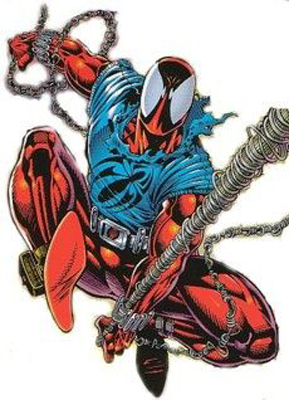
Underrated Superheroes: The Scarlet Spider

You know who I like? The Scarlet Spider.

That's right. The clone of Spider-Man.

I'm willing to concede that the clone saga never should have happened. Clone stories really seem like an artificial and silly way to induce drama into the series by having a "Who's who?" question thrown out there combined with the fact that you do eventually have to kill off the clone, because as much as every fanboy wants to see 2 Spider-Men flying around New York, it ends up getting pretty messy after 5 or 10 years.

This is exactly what they did to Ben Reilly, Peter Parker's clone, in the end. However, prior to his death, they gave him this really cool costume and identity as The Scarlet Spider. He had the same powers and personality as ordinary Peter Parker, but with a few key differences that make him cooler.

1. Being less experienced as a superhero, he was forced to be more resourceful in order to accomplish his goals. He took Parker's formula for web shooters and developed it into impact webbing - super strong balls of webbing that pack a wallop as well as some spider stingers that have a low dose of toxicity. Badass.

2. Many will disagree with me, but personally I think his costume looks cooler. It looks much more like a homemade costume, with it's solid fill red and blue instead of the intricately stenciled web designs. The external web shooters look nice, too.

3. Treading carefully with his extra inventions, the Scarlet Spider did something Spider-Man could never do: he beat Venom in an all out brawl.

All that, and he brings his own booyah.

Wednesday, March 18, 2009

Genre in Comics

Now that I've given my little rant on genre in the realm of literature, I'd like to talk about how this relates to comics. However, I can't talk about the field of comics as a whole, since there are many different subdivisions, each with their own perceptions on what comics do and where they should be going. I'm going to lump the whole medium into two categories:

1. Mainstream comics: Take note - when I say "mainstream" I am more talking about style than I am about sales. If it has the feel of a network television show, it's a mainstream comic. A mainstream comic isn't just one that includes superheroes, it's a comic that's hip, accessible, gritty, or what have you, so this camp consists of Y: THE LAST MAN as much as it does SPIDER-MAN. Most of the comics on Image, books like SCOTT PILGRIM at Oni, virtually everything on the Vertigo line, and oh, did I mention Marvel and DC?

2. Serious comics: Okay - I confess I couldn't find a good name for this camp within comics. "Underground" or "indie" seem like the most likely choices, and yet many comics like Maus or Persepolis have sold in the millions, which is hardly "underground", and with guys like Harvey Pekar and the Hernandez bros getting deals with DC and Pantheon, these books are hardly independent either. What I'm referring to is a camp within comics that consists of people at publishers like Fantagraphics and Drawn and Quarterly. Guys like Dan Clowes, James Sturm, Craig Thompson, Jason Lutes, and Art Spiegelman, who are all essentially attempting serious literary fiction within comics. These are the kinds of books that Time Magazine typically writes about.

Clearly, not everybody fits into one camp or the other. Scott McCloud is a guy that seems to hang out with the serious crowd, and yet he flirted with mainstream ideas in his sci-fi/superhero comic ZOT and even hangs out with Kurt Busiek. The Hernandez bros were always exclusively independent and yet Jaime had a lightheartedness to his early work and included a few superhero characters in LOVE & ROCKETS. Alan Moore has constantly drifted between the two, doing big mainstream books for DC in the 80's, subsequently doing serious work in the Doystevskian graphic novel A Small Killing, and then going back to doing mainstream work for Image and Wildstorm.

But, on the whole, people choose their camps and stick with em. Mark Millar's much more likely to be going out drinking with Garth Ennis and Brian Bendis at cons than he is with Chris Ware, and conversely somebody like Adrian Tomine is much more likely to write the introduction to a book by Lynda Barry than somebody like Robert Kirkman.

Aside from these "who sits with who" cafeteria type divisions, there is a clear distinction between the two camps in their perceptions of genre.

The serious comics camp tends to stick to, well, serious fiction. There's the autobiographical comics of Harvey Pekar, the slice of life stories seen in Adrian Tomine's OPTIC NERVE and the Hernandez brothers LOVE AND ROCKETS, and memoirs that range from the historical (Maus and Persepolis) to the deeply personal and confessional (Craig Thompson's Blankets and Alison Bechdel's Fun Home). While some of these stories border on the fantastical, they rarely, if ever feature elements of genres such as detective fiction, spy fiction, or the superhero.

The mainstream comics crowd tends to go for much bigger stories than the relatively austere, serious crowd does. Rarely will you see a comic from guys like Brian Bendis, Mark Millar, or Greg Rucka that doesn't feature big action, crime elements, violence, chases, explosions, and whatever else that could get your blood pumping. The visceral is favored over the mundane, the fast pace over the snail crawl, and action over introspection. Don't expect any of these guys to write any of these guys to write stories about guys that work in convenience stores.

What's interesting about these two camps is how little crossing over there is, despite the fact that some mainstream writers have the potential to do great general fiction and visa versa.

Garth Ennis, for instance, demonstrates a really firm grasp of characterization as well as some of the best, most naturalistic dialogue in the business. Both of these qualities make him seem completely prime for a personal, non-genre related story, and yet the vast majority of his published works are war fiction, Westerns, or over the top superhero parodies. Just as well, Bendis's flair for chitter chatter and drama of ordinary people that comes up in ULTIMATE SPIDER-MAN makes him seem like a great candidate to do the same. And yet, on the rare occasion when he does something that's not a Marvel comic, it's much more likely to be a crime comic than anything else.

To my knowledge, serious camp doesn't seem to decry genre elements so much as it avoids them. It's possible that people like Tomine and Spiegelman are all, at heart, huge Raymond Chandler fans, and that it just never comes up in their work. Many have, however, mentioned several times in interviews that they really dislike superhero comics. They don't like superheroes, they don't read them, and they certainly don't have any interest in writing or drawing them.

While I think it's becoming increasingly common to go from one camp to the other
(Brian Wood publishes both realistic fiction like Demo and Local as well as big sci-fi or action stuff like DMZ and NORTHLANDERS, Warren Ellis writes all kinds of sci-fi but also fits in a historical graphic novel like Crecy), for the most part, most creators stick to one or the other. Hell, most creators act like the other camp doesn't exist.

Personally, I'd like to see it more often. Let's see the folks at Drawn and Quarterly flirt with genre elements a little bit. Let's see somebody at Fantagraphics actually accept an invitation to work at Marvel. And let's see some of the Marvel and DC crowd do stories that don't feel like wannabe television shows for once.